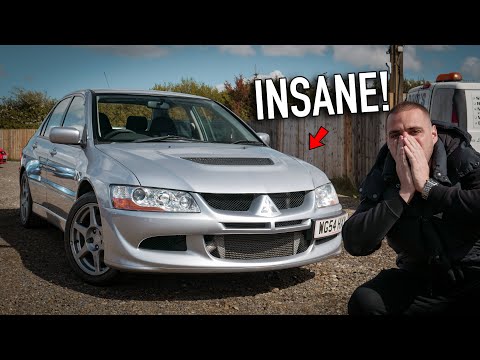
Mitsubishi Lancer Evo VIII
A rally homologation car that ran for ten generations. America got the last three.
The first Evo America was allowed to buy, and the simplest of the three it got.
11 reviewers · 21 videos · 3 hours watched
Reviewers strongly agree on its handling and fun to drive, but split on performance and daily drivability.
across 11 reviewers

"when the turbo hits this thing just Rockets forward"
Zygrene · ▶ 5:24"This new six-speed gearbox isn't quite to my liking. You don't really know where you are with it."
Fifth Gear Classic · ▶ 2:09"So there's space in the back for three children and it has a big boot."
Top Gear · ▶ 0:31"it's a very rattly Buzzy car on the inside these evos were never known to be particularly refined even in stock form"
Zygrene · ▶ 2:29Performance
4.5/511 of 11 reviewerssplit“when the turbo hits this thing just Rockets forward”
positive · Zygrene · ▶ 5:24“The Mitsubishi Evo VIII, 1 minute 28.9. Quicker than a Lamborghini Murciélago.”
positive · Top Gear Classic · ▶ 7:22“It does nought to 60 in three and a half seconds and has a top speed of 175.”
positive · Top Gear · ▶ 5:00Handling
4.5/510 of 11 reviewersstrong consensus“the handling is still quintessential Evo with just some oling and some other minor suspension upgrades the way this car turns into and out of a corner is still phenomenal”
positive · Zygrene · ▶ 10:15“The Mitsubishi is much more technical. It's got an active center differential... and it's got something called super active yaw control.”
positive · Top Gear Classic · ▶ 3:33“it just redefines what you think is physically possible.”
positive · Top Gear · ▶ 0:58Fun to drive
5.0/511 of 11 reviewersstrong consensus“It's just a fun car. I get why these are so moddable and why they're so desired to be modded and why values have stayed pretty high.”
positive · Doug DeMuro · ▶ 20:41“One-finger power sliding. There's no other car I've ever driven that could do this.”
positive · Top Gear · ▶ 2:08“it's definitely the most awesome car experience i've ever had”
positive · ThatDudeinBlue · ▶ 17:44Daily drivability
3.0/511 of 11 reviewerssplit“it's a very rattly Buzzy car on the inside these evos were never known to be particularly refined even in stock form”
critical · Zygrene · ▶ 2:29“it is pretty rough actually around town since the clutch is pretty difficult and the cams and the combination of e85 and whole nine yards it is a little tough around town”
critical · ThatDudeinBlue · ▶ 6:25“So there's space in the back for three children and it has a big boot.”
positive · Top Gear · ▶ 0:31Value
4.0/59 of 11 reviewersconsensus“it's worth somewhere upwards of twenty thousand pound”
positive · Calvin's Car Diary · ▶ 9:10“they're both relatively inexpensive Japanese Saloon cars”
positive · Top Gear Classic · ▶ 2:29“Buy an evo now because the price is not really too expensive I'm sure years from now It's very expensive”
positive · reechpotato · ▶ 17:16The VIII is the first Evolution Mitsubishi sold in the United States, sent over in 2003 after the Subaru WRX had shown the market was there. Under the bonnet is the 4G63T: iron block, 1,997 cc, no variable valve timing yet, rated at 271 hp in US trim.
Mechanically the early US car is simpler than the Evo's reputation suggests. The 2003 and 2004 cars use a viscous-coupled centre differential and a mechanical limited-slip at the rear, and the GSR has an open front differential. The gearbox is a five-speed carried over from the Evo VII. Brembos with four-piston front calipers and forged aluminium front arms are standard.
The 2005 model year is the one that changed things. The Active Center Differential and a helical limited-slip front differential became standard on every trim, and output rose to 276 hp. Active Yaw Control never came to America on this generation.
The MR arrived the same year with a six-speed gearbox, Bilstein monotube dampers, BBS wheels and an aluminium roof. It is the most complete VIII.
Where it places in the lineage: the car that opened the US chapter, and the least sophisticated of the three sold there. It shares its CT9A shell with the VII before it and the IX after it.
Hear it in the reviewer’s words




No primary articles scraped yet for this nameplate. Check back as the pipeline crawls more publications.
- MR (2005)Six-speed gearbox, Bilstein monotube dampers, BBS wheels and an aluminium roof.
US output rose from 271 hp and 273 lb-ft (2003–04) to 276 hp and 286 lb-ft for 2005; the figures shown are the launch car's. US cars never received Active Yaw Control, and the 2003–04 cars used a viscous centre coupling rather than the Active Center Differential. The five-speed is the Evo VII's gearbox; only the 2005 MR has six ratios. The CT9A chassis code is shared with the Evo VII and IX, so the code alone does not identify the car.